Schrödinger's Table
What is a neural network?
Imagine you are standing in a warehouse filled with tables. Some are round. Others are not.
For each table, you are given only two numbers.
Could a neural network learn to identify which tables are round without ever being taught the geometry of a circle?
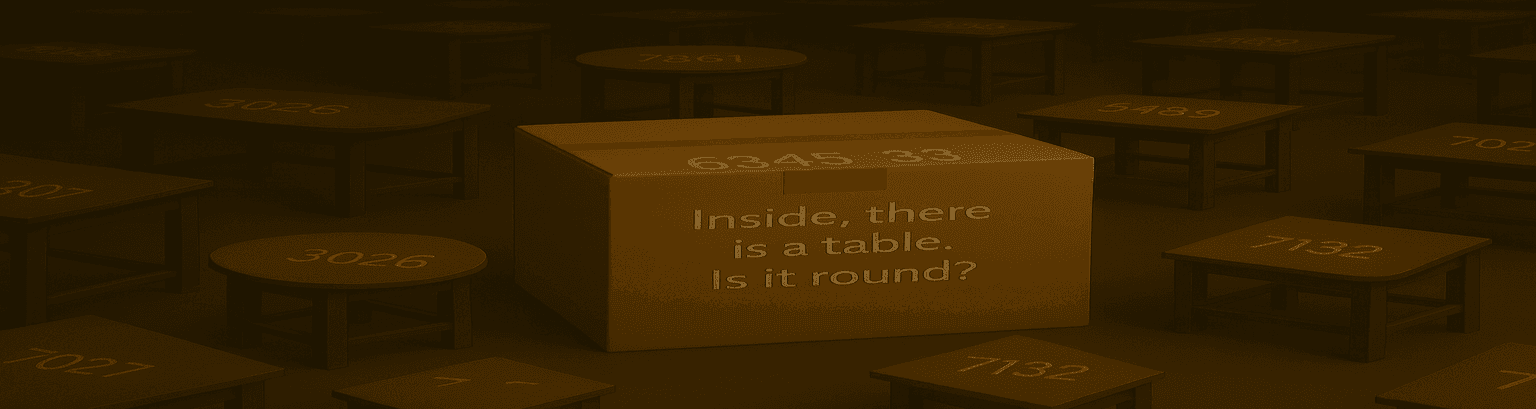
Learning from an experiment
The Schrödinger’s Table scenario is an experiment that aims to explain the nature of a neural network in a simple and engaging way.
By experimenting with the scenario, we will understand what the following is:
Dataset
How, what, and why we collect data
Train
Observe what a neural network creates and does when it trains on the data.
Prediction
See that prediction is not magic, but the result of what the neural network has created from the data during training.
Model
What is the model, and what does it represent?
How do you experiment with the scenarios?
It all begins when you find yourself in a scenario with a problem that you need to solve.
In this case, we find ourselves in the Schrödinger’s Table scenario, and the problem we need to solve is determining whether a table is round or not using only two numbers: its area and radius, without any knowledge of geometry or formulas.
Progress through the sections and see for yourself, visually, how you collect a dataset, train, and finally predict whether the table inside the box is round or not.
01
Beginning
02
Preparation
03
Start
Now try it yourself